Please click here (NOVEL) or here to view AUPO FCC compliant programs.
Where Future Neuro‑Ophthalmologists Begin Their Training
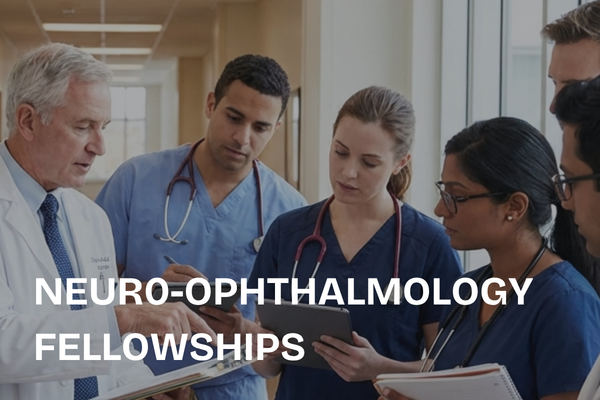
Neuro‑Ophthalmology fellowships offer the focused, high‑level clinical and academic training that prepares physicians to diagnose and treat complex disorders at the intersection of neurology and ophthalmology. NANOS supports this pathway by connecting applicants with AUPO‑FCC compliant programs, guiding them through the SF Match process, and providing access to trusted educational resources such as NOVEL and the YONO portal.
Whether you are exploring fellowship options or preparing to apply, this page brings together the essential information you need to take the next step toward becoming a Neuro‑Ophthalmologist.
AUPO FCC Compliant Programs
Non-AUPO FCC Compliant Programs
Please click here (NOVEL) or here to view NON AUPO FCC compliant programs.
The Value of AUPO FCC Compliant Programs
NANOS believes in neurologic and ophthalmic education and in the importance of neuro-ophthalmology training including fellowship training. In support of this goal, the Association of University Professors of Ophthalmology (AUPO) Fellowship Compliance Committee (FCC) is dedicated to providing a national system that will enhance patient care for ophthalmologic diseases by promoting uniform standards for fellowship training and educational programs in ophthalmic subspecialties including Neuro-Ophthalmology.
Although the AUPO FCC compliance process is entirely voluntary, NANOS strongly endorses the concept of standardization and quality in neuro-ophthalmic fellowship education. NANOS through our Professional Standards Committee has defined a set of criteria for our subspecialty constituting standards for fellowship training that include curriculum as well as research and clinical experience.
In addition, the AUPO FCC has developed general guidelines applicable to all fellowships; the establishment of fellowship requirements; and the monitoring of compliance of individual fellowship programs with these requirements. Programs admitted to the compliance program are monitored on a triennial or quadrennial program review basis to assure that they remain in compliance.
In summary, the AUPO FCC program offers educational standards, protection of the public, protection of institutions, protection of trainees, accountability and enforcement. NANOS strongly endorses programs that are AUPO FCC compliant.
AUPO Resources
Programs
- Program requirements for Fellowship Education in Neuro-Ophthalmology (Adobe Acrobat® .pdf)
- Application Question List
- New Program Application (must be submitted by May 1 for a July 1 compliance date)
- Deadlines for New Program Applicants
Program Triennial Reviews
Fellows
- Fellow Exit Survey (Requires the user account information emailed to you.)
- Fellow Exit Survey Question List
Compliant Fellowship Programs
San Francisco Formal Match Update
Attention future neuro-ophthalmologists! Applications for Neuro-Ophthalmology fellowship positions will be coordinated through the SF-Match Ophthalmology Fellowship Match for the AUPO-compliant Neuro-Ophthalmology fellowship programs. Starting from June 30th, applications will be accepted from interested applicants who are applying for fellowships starting in July of the following year.
If you are planning to begin fellowship training, please take note of the following steps:
- Register and submit your applications for a neuro-ophthalmology fellowship through the SF-Match for ophthalmology fellowships. You can access the application portal at this link. The application process commences at the end June of each year for fellowships starting in July of the following year. Application deadlines vary by program, with the earliest around the 3rd week of August.
- Review the frequently asked questions (FAQs) below for additional information.
- It's important to note that application eligibility criteria vary by program. While many programs accept applicants with a background in neurology or ophthalmology residency training, some also consider applicants with international residency training. These specifics are outlined in the descriptions for each program on the SF Match listing. If you have any questions regarding individual programs, please reach out to the fellowship director or the designated contact person mentioned for that program.
- Please be aware that the fellowship positions included in the match are AUPO-compliant. You can find more information about AUPO-compliant fellowship positions at this link. It's important to note that the match does not encompass non-AUPO fellowship positions, such as self-funded positions for international trainees, research-only fellowships, neuro-otology fellowships, etc. For inquiries regarding these non-AUPO positions, please contact the respective program director.
- If you know someone who is a potential fellow in training intending to start fellowship training, we kindly request you to share the above information with them.
FAQ - SF Match & NO Fellowships
- When are applications accepted?
- Please see the match website for timelines.
- Can international medical school graduates or international medical residency graduates apply?
- YES! Though this is program dependent. Please review the program descriptions provided through SF-match or contact programs directly to enquire.
- Can neurology residency graduates apply?
- YES! Though some programs limit eligibility to applicants who have completed ophthalmology residency, the majority of programs welcome neurology trained applicants and some only accept neurology applicants. Note that some institutions have multiple programs with different eligibility criteria. Details are contained in the descriptions for individual programs provided through SF-match. Further questions should be directed to programs.
- How do I determine which programs I am eligible for?
- Please review the program descriptions provided through SF-match or contact programs directly to enquire.
- Are all neuro-ophthalmology fellowship programs being filled through the match?
- All AUPO-FCC programs applications are through the SF-Match. Some institutions may offer research fellowships or international self-funded fellowship match which are not AUPO-FCC compliant and are not part of the match. Applications for these are directly to programs.
- *Any positions in AUPO-FCC compliant programs filled outside the match prior to June 4, 2022 will be honored.
- Can programs contact applicants after the interview?
- Programs may not initiate contact with applicants after interviews. Programs may respond to applicants if they reach out with questions or comments.
- Can programs tell applicants where they are on the rank list?
- Programs cannot inform applicants where they are on the rank list. A statement like: "You are among the best applicants I have seen so far" is permitted.
NOVEL NO Illustrated Curriculum & TDS Health Update
As of July 11, 2022, the NOVEL Neuro-Ophthalmology Illustrated Curriculum has been adopted as the official subject matter curriculum to be used by AUPO FCC compliant neuro-ophthalmology fellowship programs.
Since 2016, NANOS and Eccles Health Sciences Library of the University of Utah have partnered with Teton Data Systems to create neuro-ophthalmology products on TDS Health, an online curricular and reference platform. Contact your librarian today and ask them to add these NANOS products to your library:
- NANOS Illustrated Curriculum for Neuro-Ophthalmology with Walsh & Hoyt’s Clinical Neuro-Ophthalmology
- NANOS NOTE: Neuro-Ophthalmology Techniques of Examination for Non-Neuro-Ophthalmologists
To learn more about NANOS curricular products in Stat!Ref, contact TDS Health at www.tetondata.com, 800-901-5494. Read full press release here.